
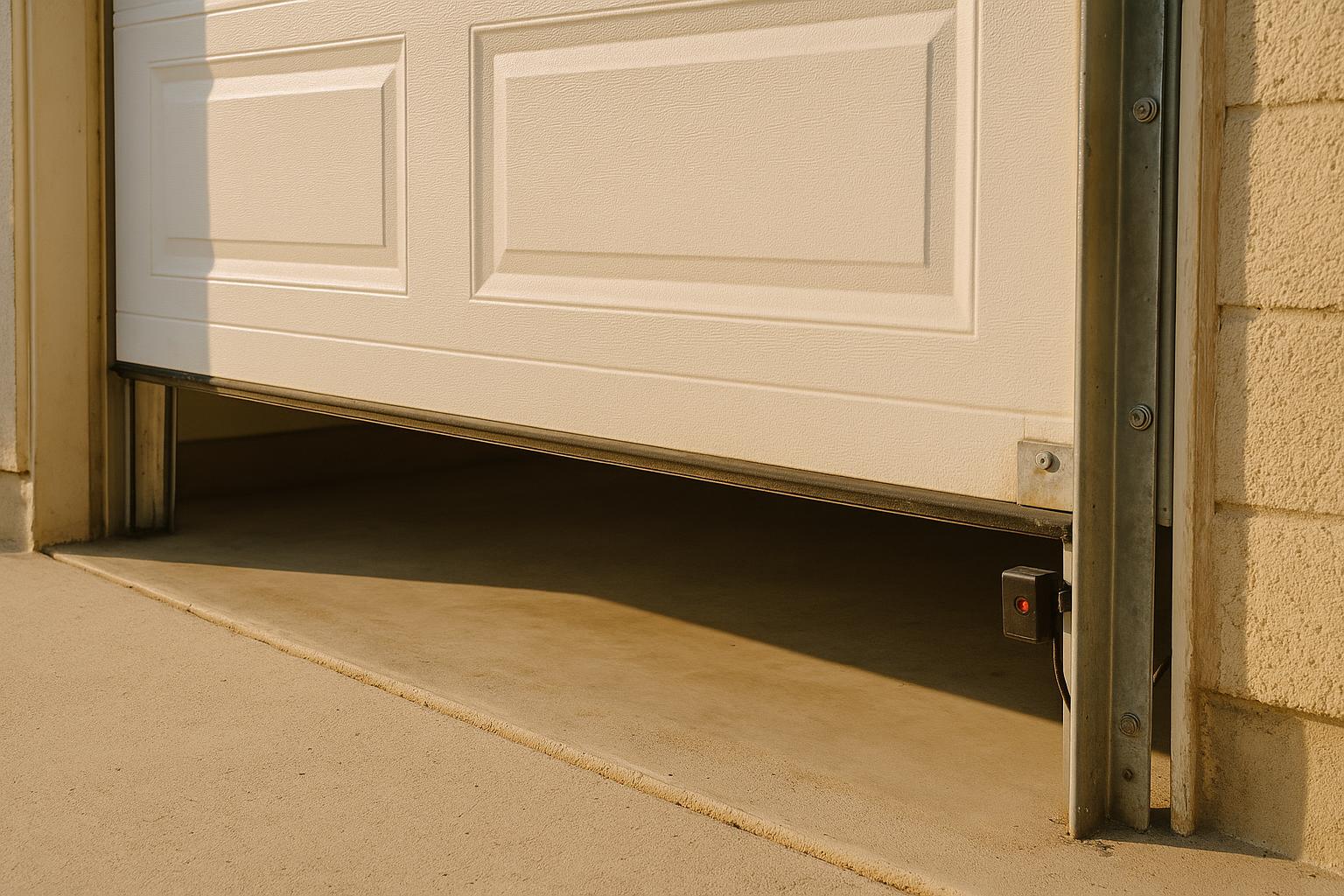
That Frustrating Moment When Your Garage Door Won't Stay Closed
You press the button on your remote, the garage door starts its descent, and then — just inches from the floor — it stops and reverses back up. You try again. Same thing. Maybe it works on the third attempt, maybe it doesn't. Either way, you're standing in your driveway in Schenectady wondering what just happened.
This is one of the most common garage door complaints we hear at Precision Garage Door, and the good news is that it's almost always fixable. The tricky part is that several different issues can cause the same symptom. Let's walk through the most likely culprits so you know what you're dealing with before you call for help.
The Safety Sensors Are Misaligned or Blocked
This is the number one reason garage doors reverse before closing, and it's the first thing any technician will check. Every garage door opener manufactured after 1993 is required to have photo-eye safety sensors — two small devices mounted near the bottom of the door tracks on either side. They send an invisible beam across the opening, and if anything breaks that beam, the door reverses to prevent crushing a person, pet, or object.
Here's what can go wrong with them:
- Misalignment: One or both sensors get bumped — maybe by a bicycle, a trash can, or even a broom handle — and the beam no longer connects. Most sensors have a small LED light that turns green when aligned and blinks or turns amber when they're not.
- Dirty lenses: Dust, cobwebs, and grime build up on the sensor lenses over time, especially in garages that see a lot of seasonal debris. A quick wipe with a soft cloth can solve this instantly.
- Sun interference: In certain seasons, direct sunlight hitting one of the sensors can overwhelm the infrared beam and trick the system into thinking something is in the way. This is surprisingly common in Niskayuna and Glenville homes with south-facing garage doors.
- Wiring issues: The thin wires running from the sensors back to the opener can fray, get pinched, or come loose from the terminals. Rodents are occasional culprits here too.
If you suspect the sensors, check that both LED lights are solid (not blinking), clean the lenses, and make sure nothing is sitting in the beam's path. If the lights keep blinking after you've tried realigning them, the wiring or the sensors themselves may need replacement.
The Close-Limit Switch Needs Adjustment
Your garage door opener has limit settings that tell it exactly how far the door should travel when opening and closing. If the close-limit is set incorrectly — even by a small margin — the opener may think the door has hit an obstruction when it's actually just reaching the floor. The safety mechanism kicks in and reverses the door.
This issue often shows up after a new opener installation, a spring replacement, or even seasonal temperature swings that cause the metal tracks and hardware to expand or contract slightly. Schenectady winters, with temperatures regularly dropping below freezing, can definitely contribute to this kind of drift over time.
Adjusting the limit switch is usually straightforward on most openers — there's a small screw or dial on the back or side of the motor unit — but getting the setting exactly right requires patience and some trial and error. If you're not comfortable working with the opener, this is a quick fix for a trained technician.
The Tracks Are Obstructed or Damaged
Garage door tracks guide the rollers smoothly from open to closed. If there's a dent in a track, a buildup of hardened grease, or a small piece of debris lodged in the channel, the door can bind or hesitate during travel. The opener interprets that resistance as an obstruction and reverses.
Run your eye along both vertical and curved track sections. Look for:
- Visible dents or bends in the metal
- Rollers that seem to catch or skip at a certain point
- Gaps between the track and the wall mounting brackets
Minor debris can be cleared with a rag, but bent tracks should be handled by a professional. Attempting to bend them back yourself can make the problem worse or throw the entire door out of alignment.
The Springs Are Worn or Broken
Garage door springs counterbalance the weight of the door so the opener doesn't have to do all the heavy lifting. When springs weaken or break, the door becomes significantly heavier. The opener strains to move it, detects excessive force, and reverses as a safety precaution.
If your door feels noticeably heavier when you try to lift it manually, or if you heard a loud bang from the garage recently, a broken spring is the likely cause. Spring replacement is not a DIY job. These components are under extreme tension and can cause serious injury if handled improperly. This is one repair where calling a professional isn't optional — it's essential.
The Opener's Force Setting Is Too Low
Similar to the limit switch, your opener has a force setting that determines how much resistance it will push through before reversing. If this is set too low, the door may reverse from the normal friction of the weatherstripping contacting the garage floor.
This sometimes happens after homeowners install new bottom seals or weatherstripping that's slightly thicker than the original. The opener meets that extra bit of resistance and treats it like a blockage. A small adjustment to the force setting usually resolves it, but be careful not to set it too high — the force setting exists to protect people and property.
When to Call a Professional
Some of these fixes are simple enough for a handy homeowner to tackle: cleaning sensor lenses, clearing track debris, or checking for obvious obstructions. But if you've gone through the basics and the door still won't stay closed, it's time to bring in someone who can diagnose the problem accurately.
At Precision Garage Door, we serve homeowners throughout Schenectady, Rotterdam, Scotia, Guilderland, and the surrounding Capital District. When we show up, we test every component systematically — sensors, springs, tracks, opener settings, and hardware — so we can identify the real issue instead of guessing. We explain what we find in plain language, give you an honest quote, and fix it right the first time.
Don't Ignore a Reversing Garage Door
A garage door that won't close isn't just annoying — it's a security risk. An open garage is an invitation for theft, weather damage, and unwanted animals. It also means your home's largest opening is unprotected, which matters a lot during Schenectady's harsh winters when freezing air can pour into your home and spike your heating bills.
If your garage door keeps reversing and the quick fixes above haven't solved it, give us a call. We offer same-day and emergency service so you're never stuck with a garage door that won't do its one job: close.